Time, Gently Bent: What a Town's Clock Tower Tells You Before the Welcome Sign Does
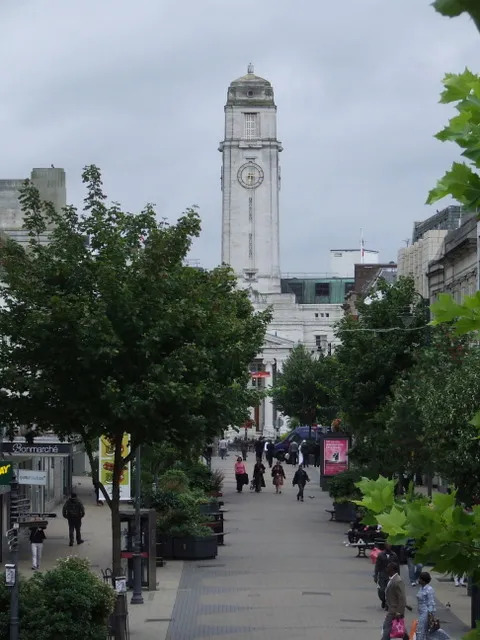
Photo: Thomas Nugent, CC BY-SA 2.0, via Wikimedia Commons
Stand at the edge of almost any British market square and conduct a small experiment. Check your phone. Then look up at the stone thing above the bank, or the iron thing on the corner, or the slightly grander thing bolted to the town hall. The two will not agree. Your phone, smug and satellite-synced, will say 10:52. The clock will say 10:58, or 10:47, or — in one memorable case — 3:15, which it has said since roughly the time of the Beatles.
Nobody around you is troubled. A bus driver glances at the tower, glances at his watch, and pulls out six minutes early with the calm of a man who has made peace with the local version of events.
This is not a malfunction. It is a personality.
The people at the top of the stairs
Somewhere behind that face is a door most people never open. Up a spiral staircase narrow enough to make you rethink your shoulders sits a mechanism the size of a small wardrobe: iron wheels, a pendulum, a ratchet, and about a hundredweight of accumulated patience.
It is looked after, more often than not, by a volunteer. Not a horologist — usually a retired engineer, a former joiner, or a man called something like Derek who describes himself as "handy". He comes on a Thursday. He carries a key that is older than he is. He writes things in a notebook in biro: gales from the west, lost two minutes this week; struck seven twice on Tuesday, investigate; wasps.
These people are the reason the clock is only a bit wrong rather than completely wrong, and they are also the reason it is not right. Because a turret clock is not a quartz watch. It is a machine with moods. Cold makes it gain. Warm makes it lose. A stiff breeze across the face can add a minute by teatime. The winders know all of this and adjust accordingly, which is a polite way of saying they guess, and then check, and then guess again.
The council's official position is "heritage"
Ask a local authority why the clock is four minutes fast and you will receive one of the great works of British bureaucratic poetry. The clock, you'll be told, is "maintained in accordance with its historic setting". It is a "heritage asset". Its accuracy is "reviewed periodically".
Translated: it's old, it's expensive to fix properly, and nobody has died.
There's a serious point buried in the comedy. A proper overhaul of a nineteenth-century turret clock — new bushes, a re-cut escapement, a specialist up from somewhere with a van — can cost more than a small park. Councils weigh that against a dial that is, in the grand scheme, roughly right. And the public, by and large, agrees with them. When a town's clock is quietly retuned to atomic precision, the letters page fills with people complaining that it's lost its character. You cannot win.
A brief history of showing off in public
Public clocks were never really about telling the time. They were about telling you something else. A town with a clock tower was a town withmoney, ambition and a railway coming. The Victorian civic building boom ran on clock faces the way modern regeneration runs on a shiny arts centre: proof that somewhere had arrived.
Then the railways standardised everything in the 1840s, and suddenly Britain had two kinds of time — the one on the platform and the one on the church. Towns that had spent decades being proudly local suddenly found themselves five minutes out from the national grid, and many of them simply declined to be corrected. It's one of the quietest acts of defiance in the country's history. Nobody marched. They just didn't reset the clock.
The lore writes itself
The stories attach fast. A clock set fast so the mill workers wouldn't be late. A clock set slow because it stood opposite a pub. A clock stopped at the exact hour of some local catastrophe and never restarted, out of respect. A clock that has run five minutes ahead "since the war" — which war, nobody will specify, and asking is considered poor form.
Every town has one of these, and every town's version is slightly different, which is the entire point. Phone time is frictionless and identical everywhere. A clock tower is a local agreement, visible from three streets away, and it tells you what a place has decided to tolerate.
What a wrong clock is actually saying
A town whose clock runs fast is telling you it values punctuality over precision. A town whose clock has stopped is telling you that the building under it changed hands twice and nobody has quite got round to it. A town whose clock is ten minutes out and still the reference point for half the high street is telling you something better: that accuracy was never the deal. The deal was that everybody looks at the same thing.
That's a rare commodity in 2026. Your phone gives you the exact time, adjusted for your timezone, for free, forever. It has no personality whatsoever. The clock above the town hall is doing a worse job and a far more interesting one — it is being from somewhere.
So next time you're in a square and the stone face disagrees with your pocket, don't correct it in your head. Take the hint. You've just been told, before you've read a single welcome sign, exactly what kind of place you're standing in.
It'll be wrong again tomorrow. Long may it be.