The 2p Ritual: Inside the Seaside Arcades Still Running on Copper and Hope
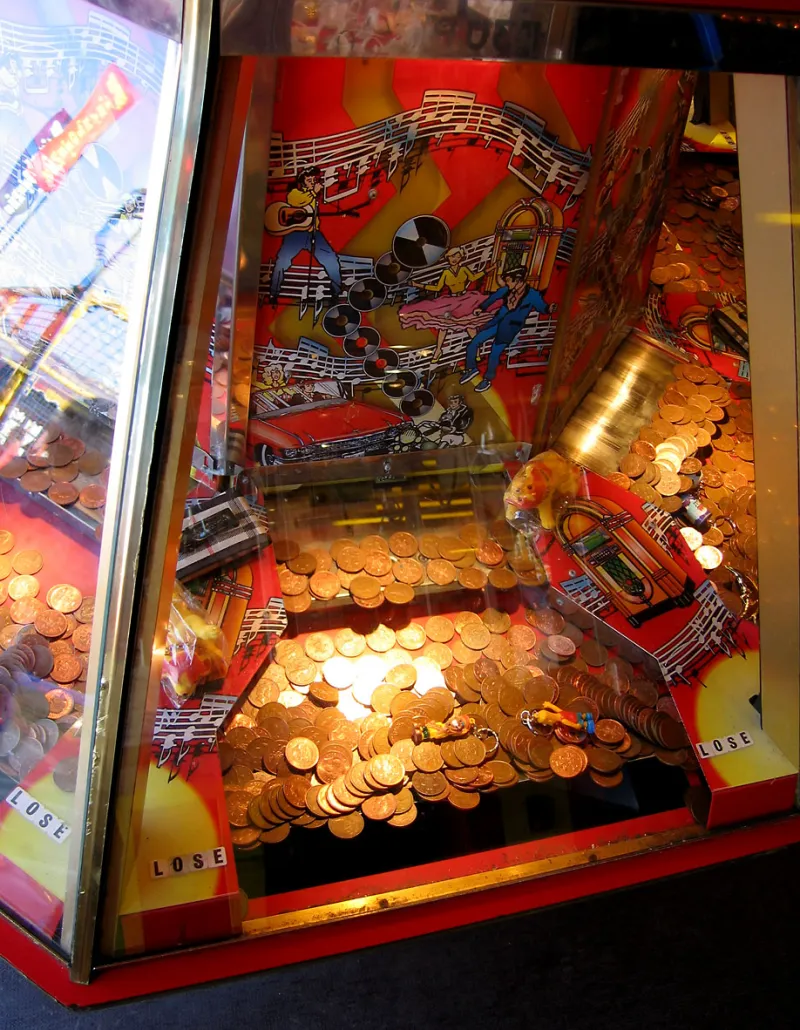
Photo: Unknown, CC BY-SA 2.0, via Wikimedia Commons
The seafront in November is a different country. The kiosks are boarded, the deckchairs are stacked in a shed somewhere, and the wind coming off the water has opinions. Then you turn a corner and there it is: a doorway glowing an improbable orange, spilling the sound of a hundred falling coins onto wet tarmac.
Inside, nothing has changed since roughly 1987. The carpet is patterned in a way that would once have been described as 'bright'. The lights buzz. Somewhere at the back, a machine is playing a tune that sounds like it was composed for a phone that no longer exists. And along the wall, in a row, sit the penny pushers — the two-pence machines, the copper falls, the shelves that sweep back and forth like a very slow, very polite tide.
The sound arrives before the door does
You hear a pusher before you understand it. There's the mechanical groan of the shelf sliding forward, then the clatter of a couple of dozen coins shifting an inch, then — if you're lucky — the cascade: a run of two-pences tumbling into the tray at the front with a noise like a tiny, cheerful avalanche.
That sound is the whole appeal. Not the winning. The sound.
A penny pusher is a simple thing. A flat bed moves slowly in and out. You drop a coin down a chute onto the bed. The bed pushes the pile toward a lip. Coins that fall over the lip are yours. Coins that don't, aren't — but they have moved the pile a bit closer for the next person. It is, essentially, a machine for redistributing small change among strangers at a rate of about eight pence per minute.
A game built entirely from tiny decisions
What makes it compelling isn't the payout. It's the decision-making, which is far more intricate than it looks. Do you drop your coin where the pile is tallest, hoping for a nudge? Or at the edge, where a single coin might tip a whole column? Do you wait for the shelf to be at the front, giving your coin the longest possible ride, or do you go early and trust physics?
There's a nudge button on most of them. It does almost nothing. People press it with the reverence of a pilot flicking a switch.
And here's the thing the moralists miss: the machine is honest. It doesn't pretend. You can see every coin. You can see the pile, see the lip, see the odds. It's a gambling machine with its workings exposed, and the house edge is a shelf moving at four inches a minute. Compare that to a scratchcard, and the pusher starts to look almost noble.
The tat is the point
Over the lip, past the coins, sits the prize shelf: the layer of items the coins are meant to topple, like a very low-stakes bowling alley. It is always, without exception, magnificent rubbish. Keyrings for towns the arcade isn't in. Plastic lighters with faded logos. Miniature playing cards. A yo-yo. Rubbery frogs. Something that might be a small purse, or might be a puzzle, or might just be a small purse.
Nobody wants these things. That is precisely why they work. If the prizes were good, the game would be about the prizes. Because they're absurd, the game is about the game — the waiting, the crowd, the shared suspense when a stack of coppers leans over the edge and holds.
The person with the bucket
Every arcade that still runs pushers has someone who looks after them, and that person is the closest thing the British seaside has to a lighthouse keeper. Their job is part engineering, part janitorial, part diplomat.
Coins jam. They always jam — usually in the chute, occasionally under the bed, sometimes in ways that require the entire top to come off. The float has to be topped up from a bucket. The prize shelf has to be restocked with more keyrings for towns the arcade isn't in. And the machines have to be watched, because a pusher that's been emptied by a lucky punter stops paying for itself within about forty minutes.
The people who do this work tend to be quietly devoted to it. They know which machines run hot, which ones jam in damp weather, which ones have a bed that's slightly out of true and therefore pays out generously to anyone who drops coins on the left. They will tell you this if you ask. They will not tell you if you don't.
A short history of the copper
Penny pushers arrived here in the sixties and early seventies, and they arrived with a problem: decimalisation. When Britain switched to new money in 1971, a whole generation of machines that took the old penny suddenly took the wrong coin. Some were converted. Some were scrapped. The survivors are the ones you see now, quietly running on two-pence pieces and, increasingly, on ten-pences, because a 2p doesn't buy what it used to and the economics have to work somehow.
That history is why they feel like time capsules. They aren't retro by design. They're retro because nobody ever got round to replacing them. The machines are survivors of a specific moment in British leisure, and the arcades around them — with their change machines, their grabbers, their coin-slide games and their faint smell of hot dust and vinegar — are the last places where that moment is still running.
Why a room full of strangers feels good
There is something quietly communal about a pusher. Nobody's wearing headphones. Nobody's scrolling. A small crowd forms. Someone's nan explains the technique to a child who is not entirely listening. Two teenagers compete over a single machine. A man in a waterproof insists, to nobody in particular, that the shelf is 'running warm today'.
It costs about two pounds to play for twenty minutes. In 2026, that is close to the cheapest entertainment in Britain, and it comes with a soundtrack and a carpet.
The off-season case
In August, these places are heaving and the pushers are stripped bare by lunchtime. In November, they belong to locals — the people who walk the dog along the front and pop in for a warm, the people who know the arcade stays open because the family that runs it has run it since before anyone can remember.
Half the seafront is dark. One door is lit. Inside, a shelf inches forward, a copper falls, and someone says 'oh, go on then'.
That's not nostalgia. That's a working machine, in a working room, doing exactly what it was built to do. Worth protecting — not because it's old, but because it's cheap, it's shared, and it still, after all these years, makes the exact right noise.