Please Sit: Britain’s Memorial Benches Are the Country’s Most Honest Travel Writing
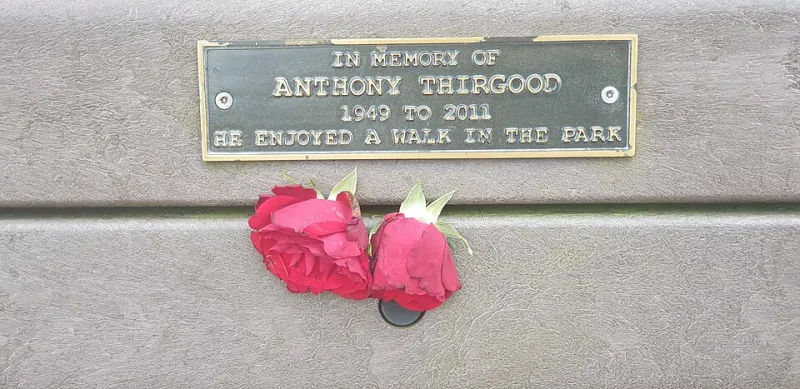
Photo: Christine Matthews , CC BY-SA 2.0, via Wikimedia Commons
There is a bench above a harbour wall somewhere in North Yorkshire with a plaque that does more for local history than the information board fifty yards away. It does not mention dates of strategic importance. It does not explain the fishing trade or the coming of the railway. It simply says that someone loved sitting there, and that they would have liked you to do the same. That is the whole pitch. And it is, frankly, better than most visitor centres manage.
Britain is covered in these seats. Clifftops, canal towpaths, station platforms, municipal parks, hospital gardens, the shady end of a village green. Some are brass, some are weathered oak, some are plastic-coated and slightly tragic. They are free, they are everywhere, and most of us walk past them without reading a word. That is a mistake. A memorial bench is not just a piece of street furniture with a sad sticker on it. It is a tiny, unofficial guidebook to the place you are standing in, written by the people who actually lived there.
The inscription is the map
Official signs tell you what a place wants you to know. Memorial benches tell you what a place actually remembers. A plaque outside a station might mention a husband who did the crossword on platform two every morning for thirty years. One beside a canal might thank a mother for teaching her children to feed the ducks there, before adding, in smaller letters, that she never once approved of the swans. A bench in a suburban park might simply say: Best view of the sunset in [town name]. No further explanation. No need.
These inscriptions are not polished tourism copy. They are domestic, specific, occasionally baffling. They mention dogs by name. They mention favourite sandwiches. They mention a person who hated walking but loved arriving. They make jokes that only three families will understand. And because they are not trying to sell you anything, they are often more honest about a place than the glossy leaflet in the café.
That is the appeal for anyone who likes a good mooch. You can learn a lot about a town by noticing where its benches are placed and what people chose to say on them. A bench facing the sea is a statement. A bench facing away from the sea, towards a car park, is a different statement entirely. A bench with a small metal plaque and a built-in ashtray tells you something about local priorities. A bench that has been repainted four times tells you the council has a budget, however small, for remembering.
A bench is a small act of local history
Memorial benches are often funded by families, friends, or collections at a local pub. Some councils run formal schemes; others simply say yes when someone asks nicely and the bench is in keeping with the park. The result is a kind of accidental archive. You get tributes to grandparents, cyclists, anglers, dog walkers, football fans, and people who spent every lunch hour in the same spot for decades. You also get the occasional bench dedicated to someone who died young, which stops you in your tracks and makes the whole enterprise feel less like quirky local colour and more like what it is: grief, made public and useful.
That usefulness matters. A memorial bench is not a grave. You do not need to know the person to sit on it. You do not need to be quiet or solemn. You can eat your chips. You can take your boots off. You can have a minor argument with your partner about whether the seagulls are getting bolder. The bench is there to be used, which is probably the best tribute of all. The person it remembers is not being preserved under glass. They are being folded back into ordinary life, one tired walker at a time.
The etiquette of borrowing a seat
There is an unwritten rulebook to all this, and like most British unwritten rulebooks it is mostly about not making a scene. If someone is clearly visiting a bench to remember a person, give them space. Do not hover. Do not take photos of them. Do not sit down next to them and start loudly unpacking a flask. If a bench has fresh flowers, a small stone, or a laminated photo attached to it, treat it like a front garden: admire from a distance unless invited closer.
If you do sit, sit properly. Read the plaque. Take a moment. Do not scrape mud off your boots on it. Do not use the inscription as a coaster for a hot takeaway cup. And if you are lucky enough to find one of those benches with a small tin of dog biscuits wedged behind it, leave a couple for the next dog. That is not a rule, exactly. It is just good manners.
How to read a bench properly in 2026
This is not a campaign to make memorial benches into a tourist trail with an app and a QR code. Please, no. The whole point is that they are analogue, local, and slightly overlooked. But 2026 is a good year to start paying attention, partly because so much of our public space is now designed to be looked at through a screen. A bench asks you to do the opposite. It asks you to sit down, look out, and think about someone you never met.
Start with the bench nearest your front door. Read the plaque. Notice what it faces. Then, next time you are in a new town, take ten minutes to find the local park, the station approach, or the canal path. Look for the seats with small plaques and worn armrests. You will learn more about the place than you will from the roundabout sign, and you will probably get a better sit down.
The bench remembers. But only if you stop long enough to read it. And in a country that is very good at official signage and very bad at admitting what it actually feels, that makes these quiet little seats some of the most honest travel writing we have.