The Concrete Cathedral Where Britain Stops for Lunch
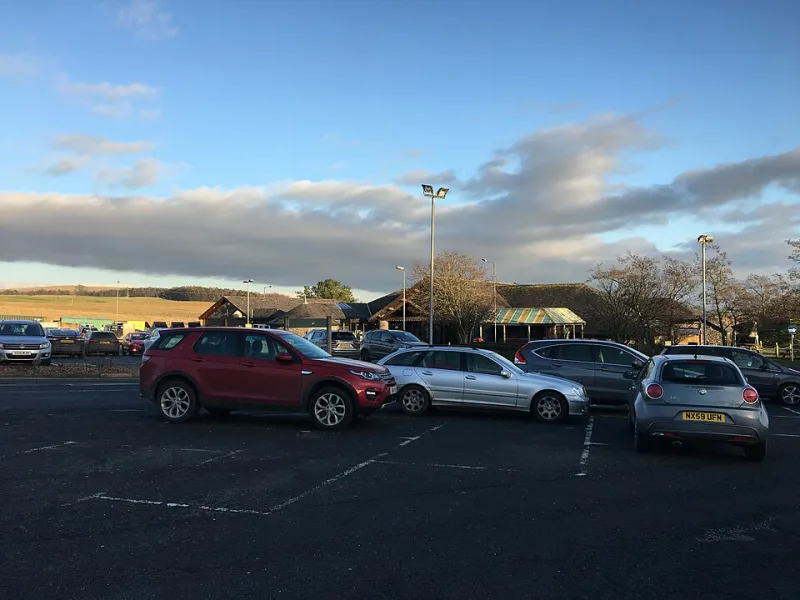
Photo: Steven Brown , CC BY-SA 2.0, via Wikimedia Commons
Motorway services occupy a strange place in the British imagination. We treat them as punctuation marks — a loo break, a limp sandwich, a chance to stretch a leg before the next stretch of grey tarmac. They are the places where families negotiate crisps, where lorry drivers queue for tea, where someone always says we will only be ten minutes. And yet the best of them have quietly become something more interesting than that. They are cultural gems in plain sight, wearing fluorescent lighting and a slightly damp car park.
The stop that became a destination
Tebay Services, tucked into the Cumbrian hills off the M6, is the obvious place to start. It has been run by the Westmorland family since the early 1970s, and it still feels less like a service station than a farm shop that happens to have a motorway attached. There is a butchery counter, a proper deli, pies that people talk about with genuine reverence, and a view of the fells that makes a pit stop feel suspiciously like a day out. You go in for a coffee and come out with a pork pie, a bag of flour and a vague plan to move to Cumbria.
Gloucester Services, on the M5, pulls a similar trick. It is the sort of place where the words farm shop are not a marketing flourish but a description of what is actually happening. Local produce, a serious bakery, a restaurant that does not apologise for itself. On a good day, the queue for coffee is long enough to feel like a village fete. On a bad day, it is still better than most high street lunch options.
Not all services are created equal
Let us be honest: Britain has plenty of services that are simply a petrol station with delusions of grandeur. The ones that matter tend to share a few traits. They have a sense of place. They stock things you would actually want to eat. They are clean without feeling clinical. And they treat the passing traveller as a person rather than a captive audience for a meal deal.
Some of the smaller stops do this beautifully. Beaconsfield on the M40 has long had a certain reputation among people who like their breaks to come with a decent coffee and a bit of architecture. Fleet on the M3 is not glamorous, but it is reliable in the way a good thermos is reliable. The point is not that every service station is a hidden treasure. The point is that the best ones are not accidents. They are designed, run and cared for by people who understand that a motorway stop is a social space as much as a fuel stop.
The ritual of the tray
There is a peculiarly British social ritual that happens in these places. You meet someone you have not seen for years, halfway between two cities, because it is the only place that makes sense. You sit with a tray of tea and a slice of cake that cost more than it should, and you catch up in a plastic chair under a skylight. It is not glamorous. It is not supposed to be. It is neutral ground, which is exactly why it works.
Then there is the family stop: the careful division of chips, the negotiation over the last bit of sausage roll, the child who has decided that the service station is the best part of the holiday. There is the solo driver who treats the stop as a small ceremony — coffee, stretch, look at the map, pretend not to check the phone. And there is the strange pleasure of walking into a place where nobody knows you and everybody is doing the same thing: pausing.
Why it matters in 2026
We are living through a period when the places we meet are getting more expensive, more bookable and more performative. The motorway service station asks nothing of you except that you turn up. It does not care what you are wearing. It does not need a reservation. It is open when the rest of the country is closed. And at its best, it is a reminder that good design and local food are not luxuries reserved for city centres and weekend supplements.
That is why the best-kept finds are not always tucked down a cobbled lane or hidden behind a church. Sometimes they are right there beside the M6, with a car park full of hatchbacks and a queue for the bakery. In 2026, the smartest thing a British itinerary can do is stop treating the journey as dead time — and start treating the stop as part of the trip.